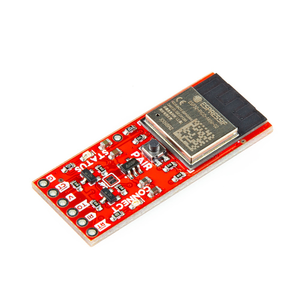
SparkFun BlueSMiRF v2

SparkFun BlueSMiRF v2 • Reviews

A product’s star rating is calculated as the average of all its reviews.


SparkFun Electronics logo

Sold by SparkFun Electronics

www.sparkfun.com

912 Reviews

4.5

The information on this page is based solely on product reviews written by customers of SparkFun Electronics via Trustpilot.


Product details

The SparkFun BlueSMiRF v2 is a highly capable wireless Bluetooth® serial link designed to replace disorganized serial cables. BlueSMiRF acts as a wireless serial UART link, allowing you to easily pair, connect, and transmit data between your TX and RX lines. It seamlessly handles any serial stream from 2400 to 921600 baud, supporting full-duplex transmissions up to 921600 bps. You can even push massive amounts of data through this link, and it will still buffer, transmit, and deliver byte-perfect streams to both radios. Upgraded Design, Better Compatibility The BlueSMiRF v2 features several improvements that we expect to streamline your workflow and make hardware integration incredibly easy: Familiar Pinout: BlueSMiRF v2 shares the exact same pinout as previous Bluetooth Mates and standard USB-to-serial converters (like our FTDI and CH340 breakout boards). Wide-Ranging Compatibility: You can connect BlueSMiRF v2 directly to the Arduino Pro, Pro Mini, ZED-F9P, ZED-F9R, UM980, or SerLCD, or to any board with a standard 6-pin serial connector. Flexible Connections: Pins on the board have been broken out to a 1x6 plated-through-hole (PTH) header, ready for your choice of headers or direct soldering. Short-Range Performance: BlueSMiRF v2 is perfect for indoor, point-to-point communication up to 100 feet (33 meters). Easy Configuration and Power Management We designed this board to be as user-friendly as possible, whether you are configuring it from a desktop or making adjustments in the field: Simple Pairing: Connecting two BlueSMiRFs is as simple as pressing the onboard PAIR button. You can also connect directly to a phone or computer for remote control and data viewing. Remote Configuration: By using a serial terminal app and a simple AT command set, you'll be able to adjust baud rates, flow control, and LED modes on the fly. Over The Air (OTA) Updates: With its built-in 2.4GHz WiFi, BlueSMiRF allows for easy in-field firmware updates. Power and Logic: We also included an onboard AP2112K voltage regulator and logic-level shifting to make all pins 3.3V to 5V-tolerant, but an RS232-to-TTL converter is required for higher voltages. While Bluetooth Classic (Serial Port Profile or "SPP") is the primary supported protocol, making it highly compatible with Android devices and most desktops and laptops, BlueSMiRF v2 also supports Bluetooth Low Energy (BLE) for connecting with Apple devices and other low-power devices. With built-in status LEDs to monitor your connection and serial traffic, this board is an incredibly handy tool for cutting the cord on your serial projects.

All reviews


Rated 5 out of 5 stars

This is a great device, supporting an LVTTL UART connection to PC through Bluetooth rather than through USB with an FTDI part or similar. The documentation is thorough and accurate, providing ample interface and functional descriptions to get the device working quickly, and background information on serial UART communication if you need it. I initially powered the device from a buck regulator powered from a lab supply, connected UART TX/RX to a Linksprite USB serial adapter and got BlueSMiRF AT command mode working. I changed the baud rate from the default to the baud rate I'm using on a development board I've been using. This particular board is powered from a 9V AC adapter and has a serial interface with RS-232 levels to a DB9 connector, requiring LVTTL level conversion to connect to a typical USB serial device. I then mocked up a 5V LDO with Schottky diode and decoupling caps. The LDO was powered from 9V, with 5V out powering the BlueSMiRF. This worked with no problems, so a 6 pin header and other components were added to one end of the proto area on the development board, with a jumper to control the 9V connection to the LDO. This is a nice, neat solution, providing an on-board wireless console interface. Wonderful job on the BlueSMiRF v2 by SparkFun!