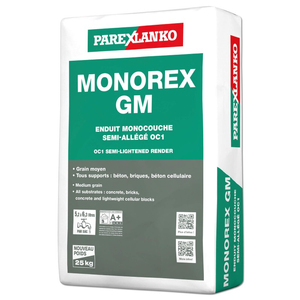
Quick Links - Click To Jump To Section: Features & Benefits Substrate Preparation Application Limitations Features & Benefits Conforms with the requirements of NHBC Render Chapter 6.11 Premier Guarantee Warranty product approval LABC and LABSS registered details BS 5628-3 Code of Practice for the use of masonry BS EN 13914-1 Code of Practice for external rendering BS 8000 Workmanship on building sites Suitable for masonry and walls conforming to BS 5628-3 and constructed from the following: Ultra-lightweight, lightweight & dense aggregate concrete blocks* Bricks Clay blocks e.g. Porotherm* Standard low and normal density lightweight aircrete blocks Breeze blocks (clinker)* Stone/rubble stone Shuttered concrete* Expanded clay insulation blocks* Clean, sound, well adhered existing render Base coats conforming to BS EN 13914-1 PAREX grey weather resistant base coats, e.g. Monogris E, Parmurex or Tradirex Dry-stacked inter-locking modular wall units e.g. Durisol recycled timber blocks Durisol with Monorex GM is NHBC approved for single skin external wall construction For below dpc applications and old substrates in accordance with BS8000 - 4 Code of Practice for Waterproofing, consult Parex *These substrates will require a suction control coat of Microgobetis 3000 Unsuitable for: Weak mortar or plaster (Gypsum) coated constructions Exposed vertical substrates with a backward incline above 10° - a backward incline may affect water run off and may have a tendency to hold moisture Painted substrates - Unless treated with Parinter Finishes: Medium Scraped Spray Textured - from tyrolean style to heavy roughcast effect Smoothed Spray Textured Substrate Preparation Substrates must be clean, sound, dust-free and free of any material which may prevent adhesion Remove all traces of plaster, paint, etc. Construction of the masonry must comply with BS 8000-3 On low suction substrates e.g. shuttered concrete or high suction substrates e.g. lightweight aircrete or clay blockwork, first apply a coat of ready-to use Microgobetis 3000 or a Monorex GM keycoat made up by adding 0.5 litres of 751 Lankolatex to the mixing water volume for a 25kg bag of Monorex GM On wet or wet patchy substrates or where different materials have been used it is advisable to apply a key coat made up by exchanging 0.5 litres of water for 0.5L of 751 Lankolatex or Fixopierre for the mixing volume for a 25kg bag of Monorex GM. Allow the key coat to fully dry a minimum of 48 hours before the application of the next coat. This suggestion will assist against the effect of ‘block ghosting’ and shade variation TV10 Mesh may also be required, dependent upon substrate condition and project specification. Application For Weatherproofing Applications to Concrete Blocks, Clay Blocks, Lightweight Aircrete Blocks, Bricks, etc. Spray Textured & Smooth Spray Textured Apply a level, compact minimum 13 - 15mm thick 1st coat Allow to dry and then spray the Textured finish The Smooth Textured appearance is obtained by pressing a plastic or stainless-steel float over the stiffened but not dry Textured finish Scraped Finish Apply a level, ruled compact 18 mm thick coat, level the surface with a straight edge, spatula or trowel flat Allow to dry (3-16 hours) and depending on the substrate and drying conditions, scrape the surface in small circular motions using a scraping tool, removing no more than 3 mm from the surface. This scraping process must remove any slight imperfections and bring the application to the specified finished thickness Each elevation must be scraped at the same stage, as early scraping will result in a slightly darker shade and later scraping in a lighter shade The minimum finished thickness after scraping is 15 mm After scraping, any dust on the surface should be removed by brushing with a clean soft bristle brush Always stand back and examine the whole surface for blemishes and unevenness. Errors must be corrected at this stage as rectification later is not practical For Decorating Waterproof Concrete & Masonry Substrates i.e. Covered With an Existing Sound & Weatherproof Render Spray Textured & Smooth Spray Textured Apply a level, ruled, lined, compact minimum 5 mm-thick 1st coat Allow to dry and then spray the Textured coat The Smooth Textured appearance is obtained by pressing a plastic or stainless-steel float over the stiffened but not dry Textured coat Scraped Finish Apply a level, ruled compact 13 mm thick coat, level the surface with a straight edge, spatula or trowel flat Allow to dry (3-16 hours) and depending on the substrate and drying conditions, scrape the surface in small circular motions using a scraping tool, removing no more than 3 mm from the surface Limitations Product intended for professional use Due to shrinkage differentials, avoid applying a thin base coat and a thicker top coat application as the shrinkage values of a thicker top coat could cause the render to delaminate from the base coat. The same effect is also caused by applying a very hard render over a softer base coat It is advisable when completing the different finishes, to take into account the hardening time, which will vary according to climatic conditions Avoid applications on substrates exposed to direct sun or in hot drying winds Do not apply on over heated substrates. In hot condition dampen the substrate prior to application and dampen the render after application Do not apply to a frozen substrate or on thawing substrates. Do not use in freezing conditions. Take precautions during damp climatic conditions (Discolouration could occur) Do not apply on very wet substrates or where there are wet patches. (Discolouration could occur) Minimum application temperatures: +5°C for light colours, +8°C for dark colours Over 30°C, special precautions must be taken In order to reduce the risk of colour differences after drying, always use the same batch number for the same façade